


| Opera Reviews | 17 April 2024 |

| Confetti
is the star of this witty Così by Sarah Noble |
|
| Mozart: Così fan tutte Opera Australia Sydney Opera House 17 September 2009 |
|
|
Conductor Simon Hewett is Sharman's lucid co-conspirator. He dashes into the pit to strike up the overture while audience conversations are still dying down and ushers still locking doors, and leads the AOBO nimbly through the shifting sands of Mozart's score, taking palpable delight in its humour while dwelling sensitively on those passages where fun and games give way to moving lyricism. If ever there were an ensemble opera, Così is it, and the collaborative spirit on display in this cast is heartening to see. Each singer takes his or her turn in the limelight, but ultimately the true star of the show is the group itself. Likewise impressive is the sterling diction displayed by all six soloists, their intelligent textual focus reinforcing the wisdom of Sharman's decision to present his Così in Jeremy Sams's clever, singable and very funny English translation. As Fiordiligi, Rachelle Durkin gives one of her finest Australian performances
to date, a sensitively rendered depiction of glamorous neuroticism. Her
stark "Per pietà" is especially beautiful, its silvered sweetness and
refinement a telling contrast to the colourful histrionics which surround
it. Sian Pendry's vacuous Dorabella is an adorable foil: her puzzled facial
expressions are one of the funniest parts of the show, and her voice,
though sometimes strident, is attractive and full of promise. |
|
|
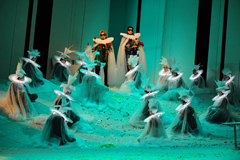
Tiffany Speight has a ball as Despina, shedding generic soubrette mannerisms to reveal a flamboyant, feisty characterisation all her own, in which "Una donna a quindici anni" becomes a sidesplitting cabaret act whose surprises are best left unspoilt. As Don Alfonso, José Carbò's bright, fluid baritone is an unexpected joy in a role usually taken by a grizzled basso, and he comes to grips with the English text as thoroughly as if were the original, proving that Australian accented vowels can be as musical as any others. The huge amount of recitative which both Despina and Alfonso must deliver has a tendency (especially in this language) to mask the basically loveliness of both Speight's and Carbò's voices, but both are in excellent form when given their chance to shine. Sharman makes stars of his production team as well. Ralph Myers's spare set is just waiting to be filled with the colour and mess which the lovers' intrigues bring, and Gabriela Tylesova's fanciful, colour-coded costumes are rich with detail, mingling twentieth century tracksuits with rococo excess. Damien Cooper's lighting design emphasises the opera's string of set pieces, vividly spotlighting key moments. Especially inspired is the show's use of live "wedding video" footage, produced by Mic Gruchy and filmed by cameraman David Ford - the close up shots of Rachelle Durkin in full, furious coloratura flight are pure genius. And then there's the confetti. From mere decoration, Sharman's Così turns confetti into a tool of expression. It is angrily thrown, lovingly scattered, rolled about in and showered under; it comes in a variety of colours and from every direction. By the end of the show, the once white stage is filled with it. It sounds frivolous and yet there's something uplifting about the optimism implicit in this symbol of wedded bliss. Sharman's Così acknowledges and explores the trials and tribulations of love with sincerity and a smile, and, with Mozart's sublime music squarely behind it, offers lovers (those in the show and those watching) hope for their future. It's a celebration - and what better way to celebrate than with buckets of confetti? |
|
| Text ©
Sarah Noble Photos © Branco Gaica |
 Jim
Sharman promised us confetti, and confetti we most certainly got. Framed
by the pristine white gleam of a Japanese wedding - whose newlyweds, pupils
at this "school for love," watch the whole show from the sidelines - Sharman's
new production of Mozart's Così fan tutte bursts with vitality,
exuberant humour and, yes, a lot of confetti. Among the varied results
of Opera Australia's recent Mozart modernisation campaign, Sharman's Così
is a gem, a witty amorous fantasy which even the sternest brocade traditionalist
should have no trouble resisting.
Jim
Sharman promised us confetti, and confetti we most certainly got. Framed
by the pristine white gleam of a Japanese wedding - whose newlyweds, pupils
at this "school for love," watch the whole show from the sidelines - Sharman's
new production of Mozart's Così fan tutte bursts with vitality,
exuberant humour and, yes, a lot of confetti. Among the varied results
of Opera Australia's recent Mozart modernisation campaign, Sharman's Così
is a gem, a witty amorous fantasy which even the sternest brocade traditionalist
should have no trouble resisting. 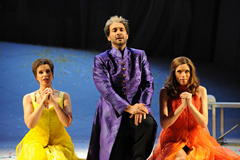 Henry
Choo and Shane Lowrencev are magnificently mismatched as the absurdly
bewigged lovers, the contrasting facets of masculinity which they depict
are as vital a part of the opera as the two sisters' vacillations. In
vocal terms, it's Choo who takes first honours, with a lyrical, urgent
account of Ferrando's challenging music. Lowrencev is an unconventional
choice as Guglielmo, a true bass singing a high baritone role. His "Donne
mie", in which the house lights (and a camera!) are turned on the women
of the audience, is outstanding, but elsewhere the role's tessitura robs
him of the rich, resonant sound he's displayed in other roles.
Henry
Choo and Shane Lowrencev are magnificently mismatched as the absurdly
bewigged lovers, the contrasting facets of masculinity which they depict
are as vital a part of the opera as the two sisters' vacillations. In
vocal terms, it's Choo who takes first honours, with a lyrical, urgent
account of Ferrando's challenging music. Lowrencev is an unconventional
choice as Guglielmo, a true bass singing a high baritone role. His "Donne
mie", in which the house lights (and a camera!) are turned on the women
of the audience, is outstanding, but elsewhere the role's tessitura robs
him of the rich, resonant sound he's displayed in other roles. 


 |